 |
 |
 |
Neorhodomela oregona
Oregon Pine
27 October 2025
Big Beach, Ucluelet, B.C., Canada.
Tide: 8.5 feet (measured at Ucluelet Tidal Station) at 12:50pm PDT (time of interaction in-situ).
Weather: Mix of sun & cloud, wind WSW 10 km/hour, sea rippled, low SW swell, humidity 70%, 11 ˚C.
Moon: Waxing Gibbous, (61.4%, 9 days); Next Phase, Full Moon, 5 Nov 2025 at 5:19am PDT: Previous Phase, First Quarter, 29 Oct 2025 at 9:20am PDT.
and:
1 November 2025
Big Beach, Ucluelet, B.C., Canada.
Tide: 4.6 feet (measured at Ucluelet Tidal Station) at 2:50pm PDT (time of interaction in-situ)
Weather: Mix of sun & cloud, wind WNW 10 km/hour, sea rippled, moderate SW swell, humidity 70%, 11 ˚C.
Moon: Waxing Gibbous (81.0%, 11 days); Next Phase, Full Moon, 5 Nov 2025 at 5:19am PST: Previous Phase, First Quarter, 29 Oct 2025 at 9:20am PDT.
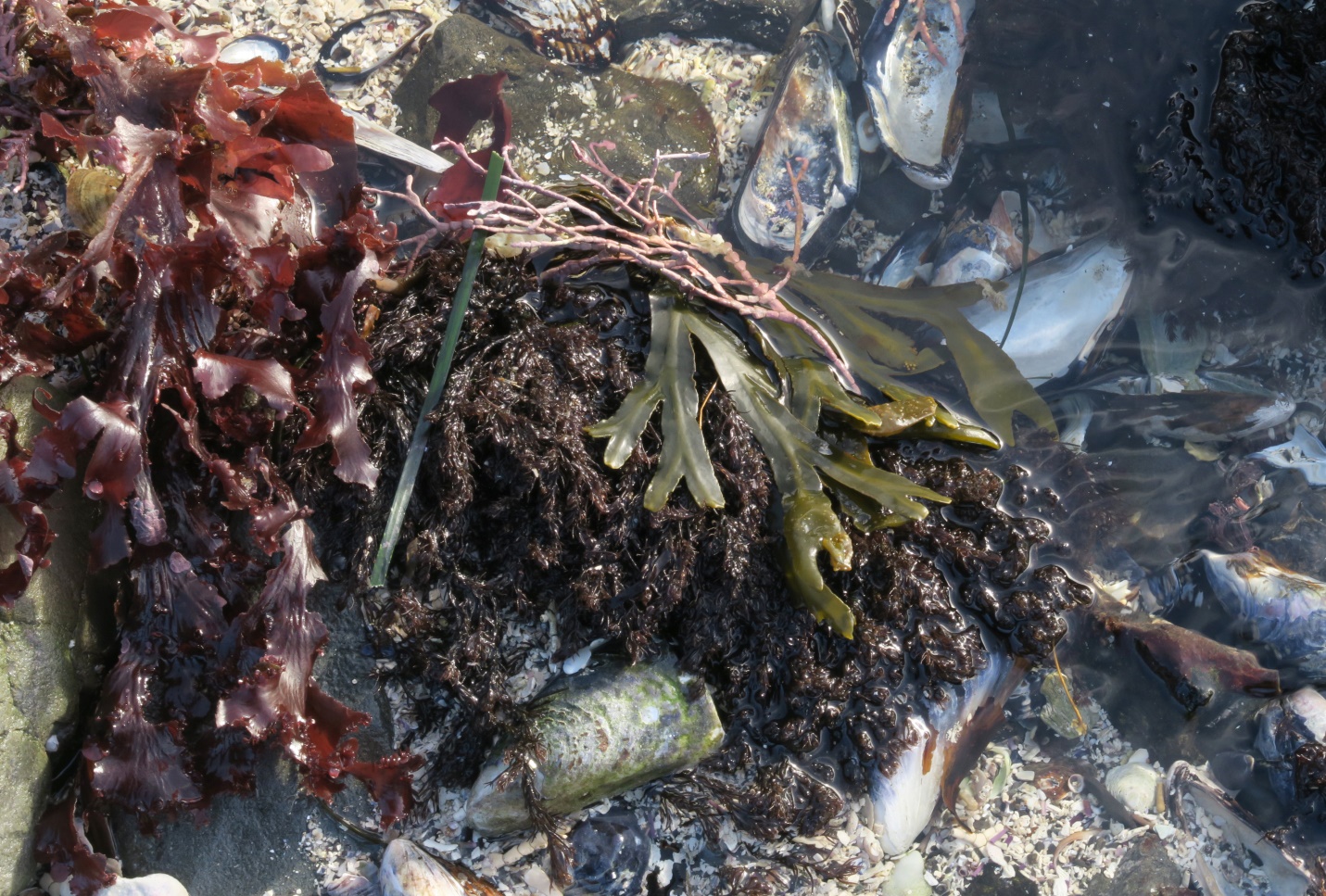
Figure 1: Only one of the seaweeds pictured above is affixed to the substrate and had not been cast ashore with the most recent storm swells – that is the very dark brown/black one underneath the olive green Fucus distichus and to the right of the red Cryptopluera/Hymenena sp. alga. Neorhodomela oregona is growing affixed to rock here in this region of the mid intertidal zone. It is located more precisely in a slightly lower lying area which has been created by a channel of freshwater flowing through. The location also receives the first touches of sea water flooding in on an incoming tide. Big Beach, Ucluelet, B.C., Canada. November 1, 2025. Photo ID 27851 ©Seaweedwhisperings.com
Person 1:
Clasp.
Clench.
Hold on tight.
Resist.
Drag.
Stubborn.
The above traits came “fast and furious”, one following the other in rapid succussion. Also noticed that more than usual I’ve been using one-word descriptions.
Has an obvious showy presentation that hides the secretive nature of its being.
Appears robust and “out there” when in a group, but if a thallus is spread out (as we did for photography), it is thinner and more wiry.
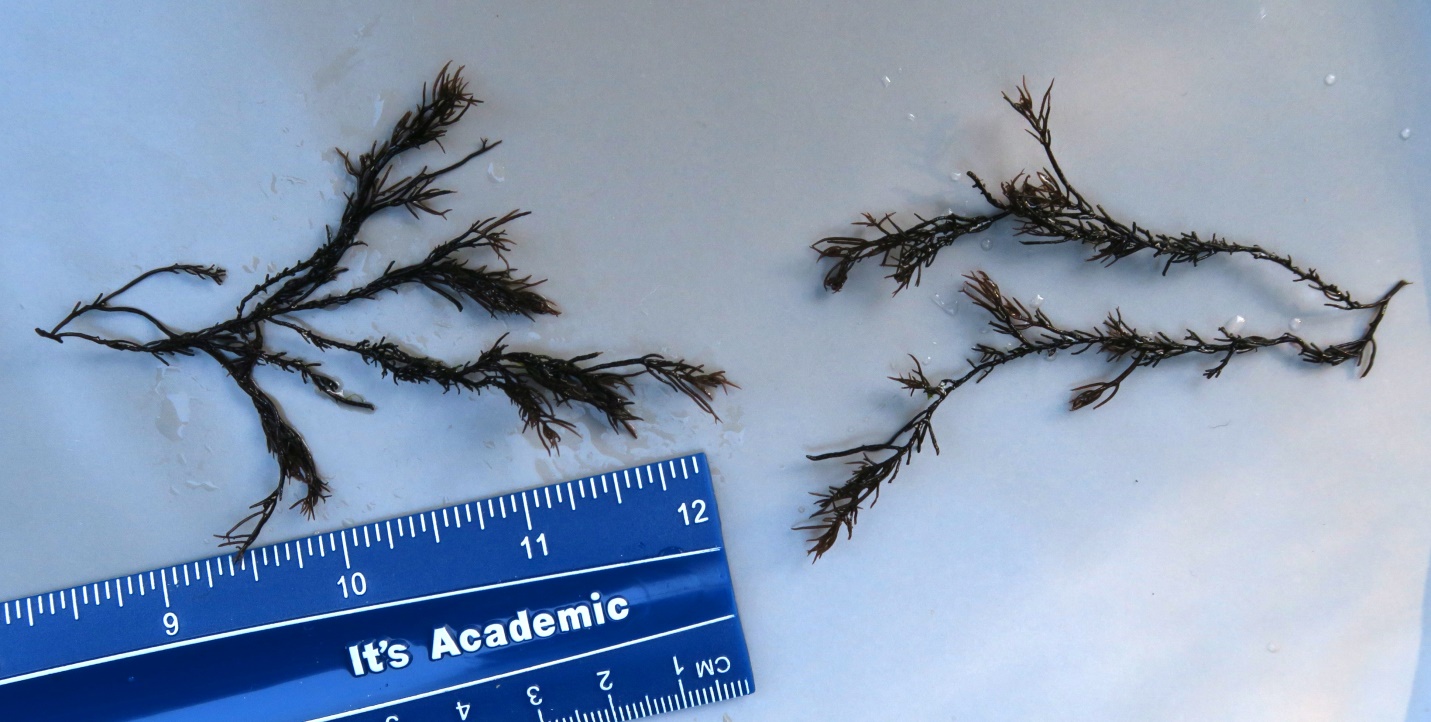
Figure 2: Individual thalli viewed singly can look far more wiry than the ‘group look’ of this species in situ. There is a disorganized feel to this species of Neorhodomela that doesn’t “show” unless you look closely – they hide things well in their dark colored and rather self-sufficient appearing clumps. Big Beach, Ucluelet, B.C., Canada. October 27, 2025. Photo ID 27852 ©Seaweedwhisperings.com
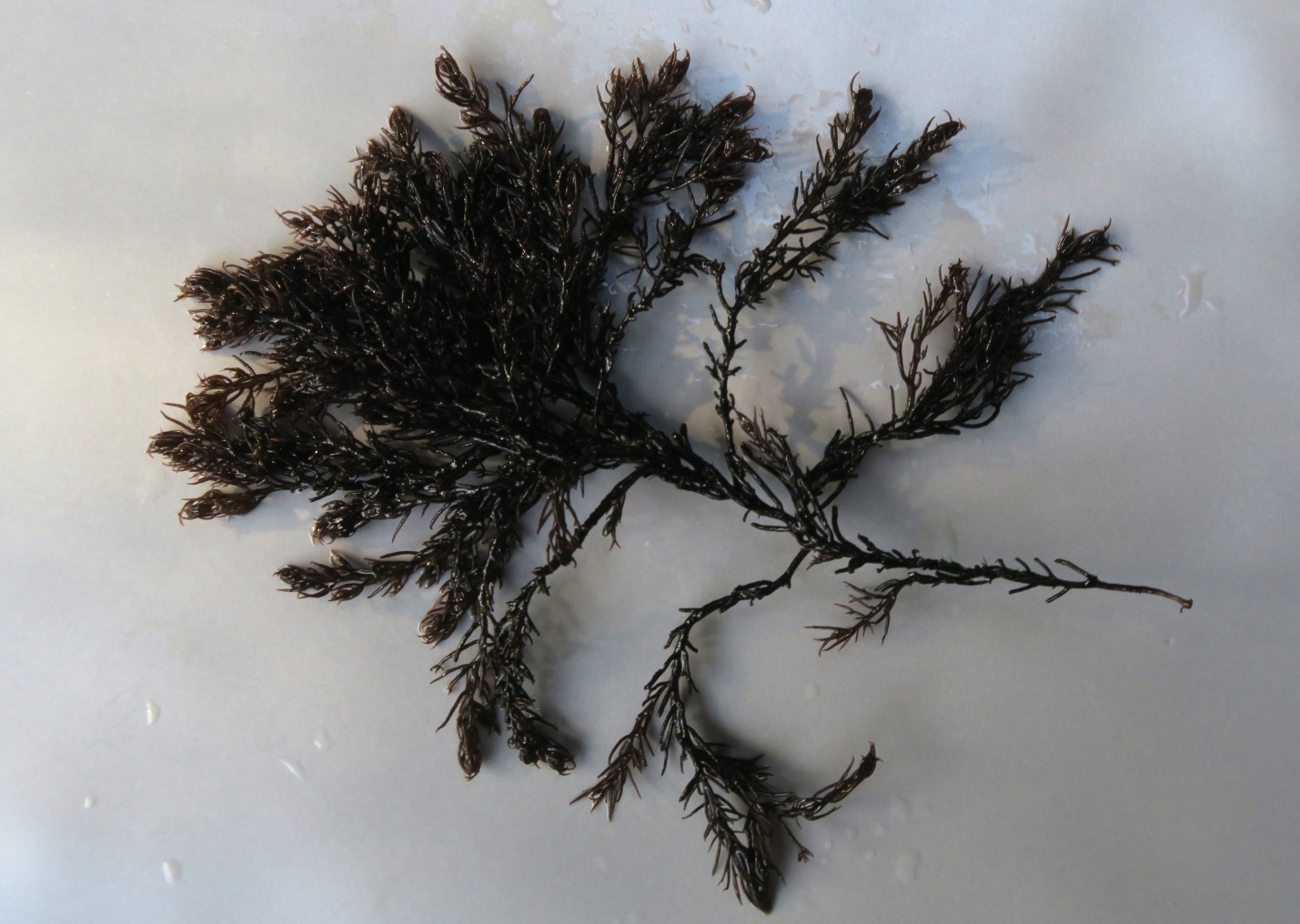
Figure 3: Another thallus viewed on its own. The more profuse branching is one feature that distinguishes this as Neorhodomela oregona and not its close relative, Neorhodomela larix. Big Beach, Ucluelet, B.C., Canada. October 27, 2025. Photo ID 27853 ©Seaweedwhisperings.com
Person 2:
It took a bit of investigation to confidently settle on your identification, Neorhodomela oregona. Our query started five days ago when we first saw you here at Big Beach. We went back and forth on whether you were a Neorhodomela or an Odonthalia species. In fact, we came to finally conclude, you are the closest Neorhodomela (morphology-wise) to Odonthalia, and we learned that your earlier scientific name even was Odonthalia oregona!
So, while we were back and forth-ing on this, we went from a certain feeling that you were a Neorhodomela to an intellectual doubt that we could prove this to be so. This kind of ‘viscous circle’, between certainty and doubt, was intellectually interesting and almost entertaining, but it also felt frustrating due to the number of times we’d recanted our decision. When we let go and simply rested in our indecision, it was interesting what next happened – we visited the seashore again and looked very closely at some Oregon Pine to gain identification clues. We came up with some answers and also some more questions and with that we burst out laughing. Humor had entered into the debate and it was delightfully appropriate, even helpful.
This whole process had me considering your species name – oregona; Oregon is a vast territory named by in-comers who knew nothing of the land, its lakes, rivers, seacoast, its animals, birds, plants and sea life. So very much was truly unknown to them about this region, the ones who named it ‘Oregon Territory’, and it contained so very much to explore. I think these qualities – acknowledging that there are many unknowns to be explored, is a part of your energy, Neorhodomela oregona.
You have stiff, very dark red (almost black) thalli that grow in clusters. All along your central axes there are short, spiny-looking branchlets (that could be described as resembling the needles of a pine tree or some short needled conifer). You also produce some branches off your main axis, and these are similarly clad with the short needle-like branchlets.
The thing about these short branches and the ‘needles’ themselves, is that they look somewhat succulent or fleshy but they are also stiff, and they arise from the central axis in a loose spiral pattern. So Neorhodomela oregona never lies flat on one plane. You can see this in its habitat. Even if exposed and left out of water for some time, the numerous thalli do NOT collapse or flatten atop each other; instead they are stiff enough to lie like sets of springs – touching but not compressing or impinging on the spacing created by the needles of other adjacent thalli.
You can handle the conditions of the mid-intertidal zone, even the high mid-intertidal areas. This means you receive a fair bit of exposure. Perhaps the succulent-like nature of your parts is necessary for retaining enough moisture. Today I also noted that while remaining firmly attached to your anchor rocks, with the fall and winter low tides you can take advantage of the “cover” of other cast ashore algae (see Figure 1) and this will help minimize desiccation. In the summer low tides, I think things would be more stressful for you in this regard as low tides occur in peak daylight hours and time of exposure is greater, too. Perhaps summer is really not your season, N. oregona.
When a water current moves you, your numerous thalli can line up in fairly parallel arranged rows, but when immersed or also when exposed out of water, your thalli seem to each seek their own different destinations (see Figure 5). The different directions seem to be a preferred state.
So you are independent, whilst looking quite the same as your neighbors.
You will stand apart, but not in a showy way.
You are dark colored and in the background.
You don’t like to be crowded and you don’t choose to crowd others either. This can seem like a contradiction because from a distance your clusters of thalli can look crowded, but for each Neorhodomela oregona thallus they all are maintaining their appropriate and necessary distancing. They are really quite independently engaged but this would not be easily understood by appearances alone.
You have a close relative called Neorhodomela larix, and you differ from that species mainly in that you have relaxed your spiral form to a more open, spacious and even somewhat random one. N. larix has a tightly coiled spiral; N. oregona retains the spiral but it is very much less compressed and concentrated. What does this give Neorhodomela oregona? It feels to me that in the spaciousness there is something going on..., either some extra growth or some extra exploratory ventures or some extended consideration taking place and even there could be some simple ending of their interest in the ‘current program’ for a while..., and then N. oregona will put out another branchlet. There are still enough branchlets to maintain the helix of protected space around the axis, but there doesn’t seem to need to be as many branchlets to protect the forward growth of the central axis.
This gives N. oregona a more ‘vulnerable’ or less guarded look compared to N. larix and also it looks less ‘organized’. And I think Neorhodomela oregona can feel more exposed, however, they know that this added vulnerability is the cost of their inquisitive and exploratory nature. Can they get carried away with this? Certainly the drive to continue exploring feels strong, but sometimes I think N. orgeona can find that there can be too much to take in and then their sense of being able to organize is stressed. They don’t like to feel this disorder, but they also don’t want to miss out on exploring. This is a conundrum they live with.
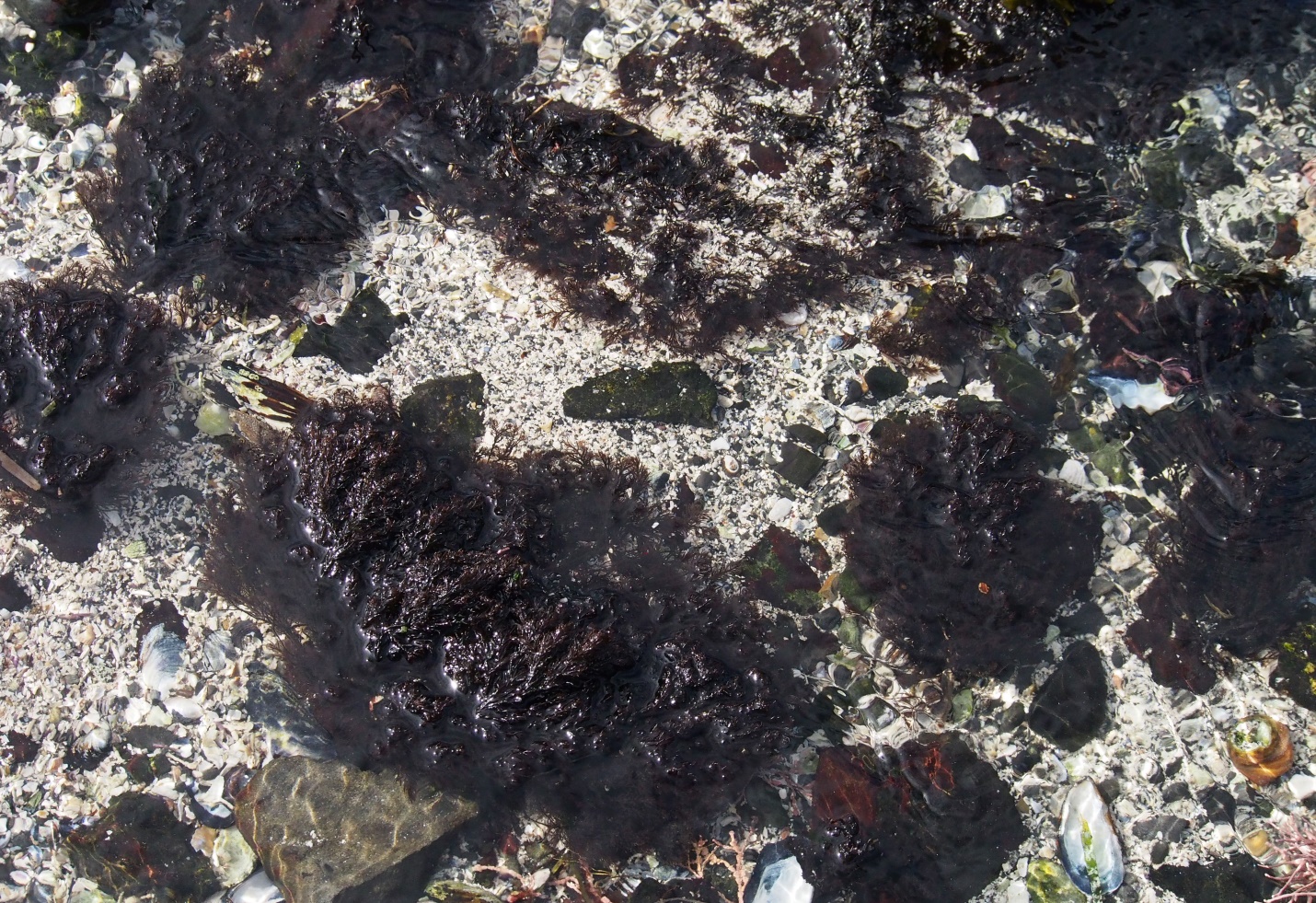
Figure 4: Here at Big Beach the clumps of Neorhodomela oregona are not hiding, they’re even conspicuous – that is if you take a look at dark colored algae that can tend to blend into the background as they are scattered among and affixed to dark cobble and other seashore features. Were it not for all the white shell fragments here, this very dark red seaweed would blend into the background quite nicely. Big Beach, Ucluelet, B.C., Canada. October 27, 2025. Photo ID 27854 ©Seaweedwhisperings.com
Discussion:
In its habitat, this macro alga stands out and can be ‘showy’ because it grows clumps that are not hidden and could even be called conspicuous. And this conspicuous quality is partly due to the fact that it is growing where there are not many other algae. In fact, it would be conspicuous at all if there were many other species living in the same intertidal zone. In that situation it would blend into the background. So the quality we feel this observation is pointing us to is that Neorhodomela oregona can do well where others don’t even try. And it’s tough enough to live in vulnerable or exposed areas.
A word came to mind and that is “relict”. We found ourselves wondering if this seaweed has aspects that relate to being left-over from an earlier period in time. Its rather isolated position could arise from newly colonizing fringe habitat opportunistically, but the feeling here is more one of a few survivors remaining from an earlier time. The clasp, clench, hold on tight, resisting “letting go” attributes found certainly could tie in with the concept of relict, too.
Person One noted that Neorhodomela oregona has some showiness and this serves to hide their “secretive nature”. This led us to consider, what does it want to keep secret, and why…? To explore this question we took a look at key words from Person Two’s interaction with the seaweed. We considered the following: back and forth; certain feeling versus intellectual doubt; vicious circle of indecision; many unknowns to be explored. From these concepts we got the sense that Neorhodomela’s energy needs to keep things secret until the ‘unknowns’ have been explored sufficiently to their satisfaction. It also seemed that interruptions would only hamper them in reaching this point. So with this energy the following aspects also were strong indicators: stiff, grows in clusters, spiral pattern creates helix and maintains space between thalli; bouncy springs lying atop each other but don’t collapse. ‘Space’ and however that might be ‘measured’ seems to be valuable to the process of sufficiently exploring.
And while there is a thoroughness or determination to explore the many unknowns before arriving at any conclusions, there is in this seaweed a willingness to not close down to ongoing or further input. We saw this in the following traits: positioning of small branches along the central axis is more open, spaced out, even random looking; in comparison (to a near relative) it looks more vulnerable and less organized; no particular direction, random, perhaps more sensitive to its surroundings, can pick up more from a wide variety of angles. So, it is an interesting thing to consider this state where one is very close to arriving at interesting determinations, that it has within it the likelihood to have all that postponed because new input has arrived from random places. We felt that there has to be an acceptance of some level of disorder as that is the cost of remaining open in ongoing explorations.
It is obvious that sometimes these explorations may take a very long time, especially if one does not close the door to new input; the concept of relict and the strong water retention abilities showed us that Neorhodomela oregona is prepared to be involved for the ‘long haul’.
It took some time to sit with the energy of this seaweed to “make sense” of what first felt like disparate or seemingly unrelated parts. We feel certain that this can be part of the routine experience of Neorhodomela oregona – that patience is required otherwise it will feel difficult or even impossible to pull things together into a satisfactory sense of understanding and completion.
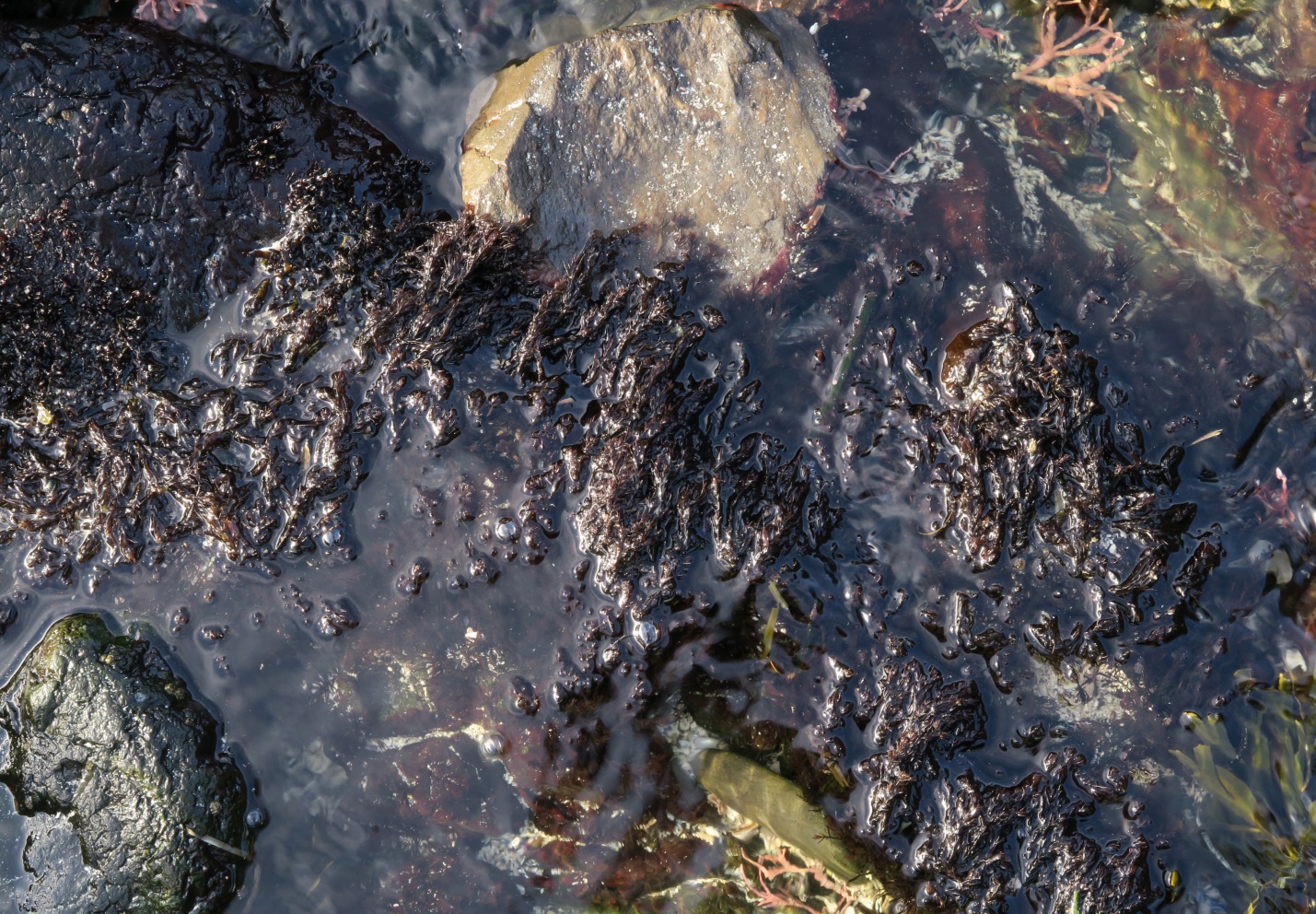
Figure 5: Hydration! Pictured here this seaweed is enjoying an area of wet seeps, and the morphology of this seaweed serves to assist with water retention – a necessity for life in the relatively high intertidal zone. Big Beach, Ucluelet, B.C., Canada. November 1, 2025. Photo ID 27855 ©Seaweedwhisperings.com
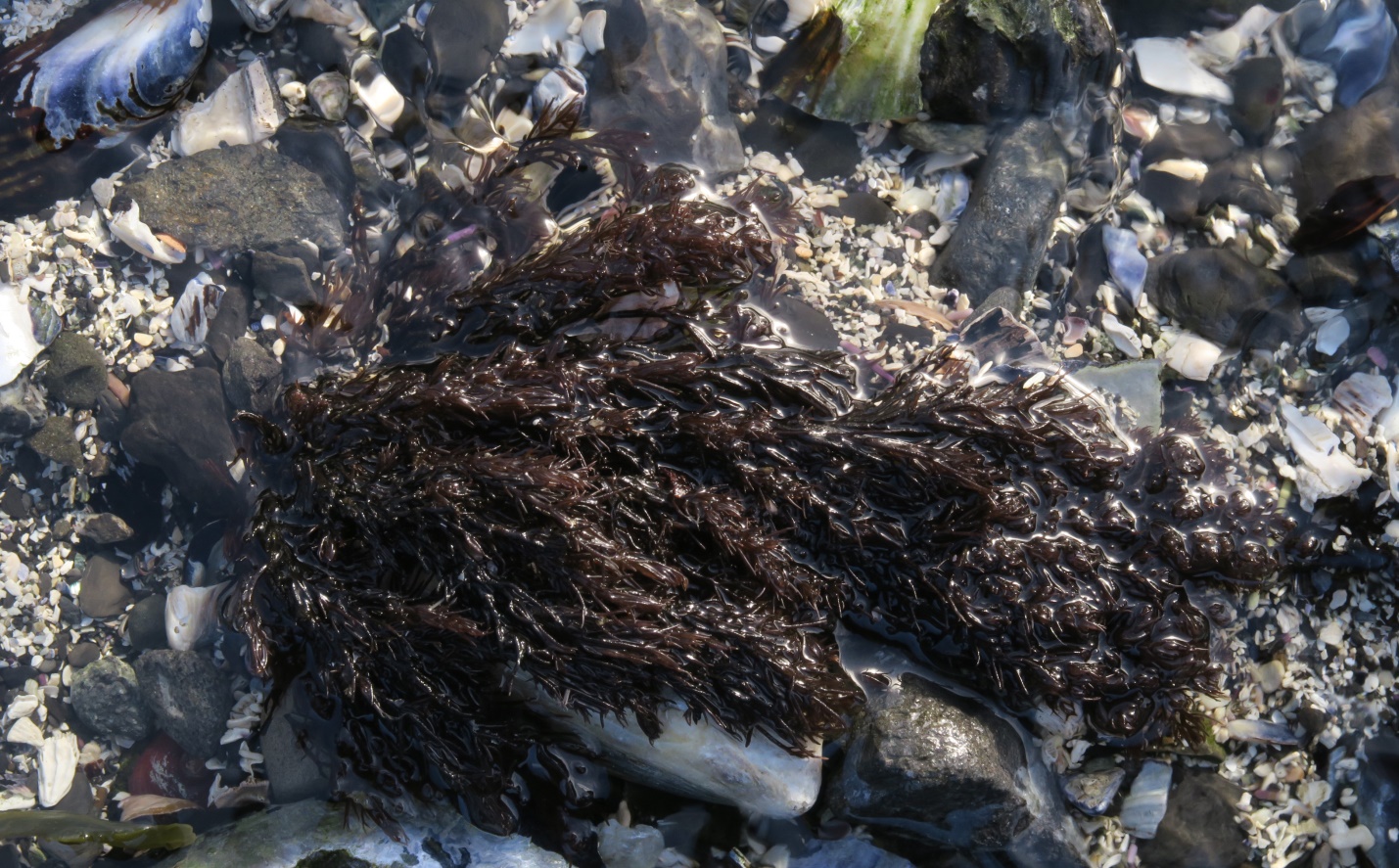
Figure 6: A close up and larger than life view of a relatively small clump of Neorhodomela oregona. At a distance this seaweed looks nearly black in color but here the deep reddish brown is apparent, hinting at this seaweed’s place within the red macro alga – Rhodophyta. Big Beach, Ucluelet, B.C., Canada. November 1, 2025. Photo ID 27856 ©Seaweedwhisperings.com
Biology & Natural History Information:
Description:
Thallus is coarse, color is a uniform dark brownish-red to black, and overall height reaches to 20 cm tall. Branching of main axis is primarily indeterminate, with slender, terete, radially arranged branches. Several upright thalli arise from a common expanded basal disc (discoid holdfast). The first order of branches is short, up to 2 cm long and bear progressively shorter and more slender branches. Branchlets arise in a spiral manner and are also slightly rigid in texture. Oregon Pine (Neorhodomela oregona) is similar to Black Pine (Neorhodomela larix), however has differences which are not difficult to discern in the field. Oregon Pine is not quite as coarse and stiff as Black Pine, and its branchlets are not so obviously bunched. Oregon Pine also has more orders of branching and looks quite wiry.
Habitat:
This resilient perennial is found on rocks and can form dense carpets in favorable conditions. It often occurs in tide pools and areas where there are wet seeps, typically in the mid intertidal of semi-protected or more protected shorelines.
North Pacific Distribution:
Bering Sea and Aleutian Islands, Alaska to Sonoma County, California; Japan; Russia.
Remarks:
In our own field observations we noted that Neorhodomela oregona has a morphology that is somewhere between Odonthalia and Neorhodomela, especially if when referring to botanical drawings in the Marine Algae of California. It turns out that Odonthalia oregona is, as Masuda, M. published his work on the tribe Rhodomeleae in 1982, conspecific with Neorhodomela oregona. Odonthalia oregona was transferred by Masuda to the Neorhodomela genus on account of the spiral branching, the dorsiventral arrangement of vegetative and fertile trichoblasts, and the spermatangia borne on the trichoblasts.
Classification:
Empire: Eukaryota
Kingdom: Plantae
Subkingdom: Biliphyta
Infrakingdom: Rhodaria
Phylum: Rhodophyta
Subphylum: Eurhodophytina
Class: Florideophyceae
Subclass: Rhodymeniophycidae
Order: Ceramiales
Family: Rhodomelaceae
Genus: Neorhodomela
Species: Neorhodomela oregona (Doty) Masuda 1982
Former name(s): Homotypic synonym: Odonthalia oregona Doty 1947
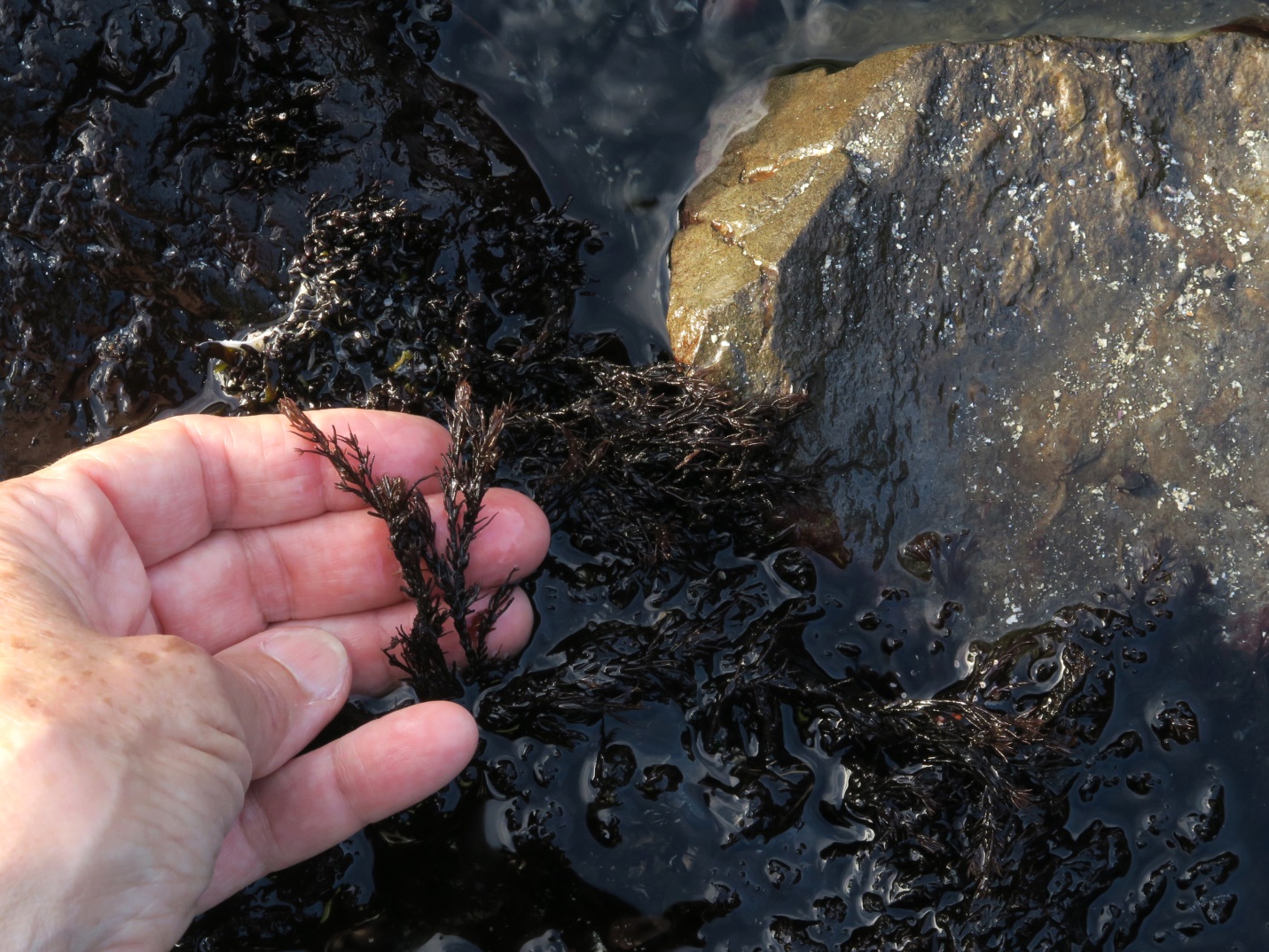
Figure 7: A look at the ends of two thalli of Neorhodomela oregona reveals some of the ways this seaweed chooses to meet its environment. The individual thalli have a bit more of a disorganized appearance to them in comparison to that of the overall clusters. Big Beach, Ucluelet, B.C., Canada. November 1, 2025. Photo ID 27857 ©Seaweedwhisperings.com
